The Debate; the Discourse – is how it appears at first. Just asking questions, with secret winks and dogwhistles – testing the waters to see the response. Maybe it is an important question whether trans athletes are unfairly advantaged to limb length. Maybe it is an important question whether it is violence when Postmodern Theory proposes that we shouldn’t use gendered language in healthcare surrounding wombs and dick. Maybe it is an important question whether it is reasonable to have ”single sex spaces” for women that excludes trans women. Maybe it is important to have a public debate about these questions to find out the correct answer – which is decided by the generation of reactionary outrage, which we all know predictably arrives due to the way that (social) media works, and the way the questions are posed.
Or, maybe that is actually a very terrible idea and a death trap for the possibility of change.
Therefore, this text will be somewhat of a polemic. I will not be citing tweets, accounts, or give names of the people I am intending this text to be about, and for many reasons. It is a show trial.
Firstly, I have no interest in a personal conflict, exchanges of linguistical bludgeonings. I do not want to make anyone personally feel threatened, since I believe that might only accelerate transphobic radicalization.
Secondly, I do not think it is a problem best viewed at the level of individual people – but rather as a movement with ever changing tactics, decided by selection pressures. A reactionary life-form, slowly revealing it’s face – while us who are the primary target have seen through the disguise all from the start.
Thirdly, besides ”debate” being useless, if not harmful – I am not a debater or worse, a politician. I have nothing to gain from debate, from direct conflict, except anxiety. I am more interested in structure, movements, and concepts:
Ours is the age of communication, but every noble soul flees and
What is Philosophy? Gilles Deleuze + Felix Guattari
crawls far away whenever a little discussion, a colloquium, or a
simple conversation is suggested. In every conversation the fate of
philosophy is always at stake, and many philosophical discussions do
not as such go beyond discussions of cheese, including the insults and
the confrontation of worldviews. The philosophy of communication
is exhausted in the search for a universal liberal opinion as consensus,
in which we find again the cynical perceptions and affections of the
capitalist himself.
In this text, I will start by attempting to describe characteristics of the ideology I am concerned with, followed by a description of the term Workerism. After that I will attempt to prove their similarities. At last, I will try to list the harm this ideology brings, if not already clear, and also my personal connection with it – before I attempt to bring it all together in a conclusion.
Ideological Positions
Talking about what the feminism I mean is, is difficult because I neither want to start needless conflicts by naming people or accounts – or myself too fall victim to a confusion of concrete and general, for example by positing my experiences with single people as general for a group that doesn’t really exist including online personalities who probably themselves doesn’t feel apart of that group. Instead of thinking of it as a coherent group, I will think of it as a non-coherent community – patterns of familiarity, of congruence, between many people – but that do not always agree with each other, but will tolerate each others positions.
I think the feminism could be described as a modern radical feminism that attempts to not be overtly transphobic – even if it is sympathetic to some of the aims of the gender critical movement.
MATERIALISM: MATERIAL GENDER
First of all, completely central to the ideology I am speaking of, is the usage of the term materialism as something of an empty signifier. The usage of it always brings to mind Strouds text on naturalism – which is more or less what philosophical materialism (except for in leftist theory due to Marx being such a central figure) evolved into once we left the 19th century:
”Naturalisms” seems to me in this and other respects rather like ”World Peace.” Almost everyone swears allegiance to it, and is willing to march under its banner. But disputes can still break out about what it is appropriate or acceptable to do in the name of that slogan. And like world peace, once you start specifying concretely exactly what it involves and how to achieve it, it becomes increasingly difficult to reach and to sustain a consistent and exclusive ”naturalism”. There is pressure on the one hand to include more and more within your conception of ”nature”, so it loses its definiteness and restrictiveness. Or, if the conception is kept fixed and restrictive, there is pressure on the other hand to distort or even to deny the very phenomena that a naturalistic study – and especially a naturalistic study of human beings – is supposed to explain.”
THE CHARM OF NATURALISM, Barry Stroud
Materialism in itself does not mean anything unless we have a common definition of it. To make my critique more fair, I will fill in some blanks not present in public discussions wherein it is used as a linguistical bludgeon, but are there if you would probe deeper, or have a longer conversations with the perpetrators of it: material gender is defined as a societal class created by their function in a larger system, in this case, patriarchy.
So, if what women are to patriarchy is similar to what the worker is to capitalism – what is the role woman play in patriarchy in which they have unique access to the means of its continuation? Reproduction, or more general – reproductive work.
This is the classic radical feminist perspective, which obviously runs into problems if you want to include trans women as allies in the fight against patriarchy. As a solution to this problem, more ideas can be borrowed from marxism – for example, base/superstructure. In this case, the ”material base” is womanhood as a class defined by reproduction – while the superstructure is the culture that arises out of it, leading to the ideology of patriarchy – the social oppression of women. This social oppression is something above and beyond only the material, but is still shaped by it, and somewhat bound by it. Therefore, of the two oppressions – social, and biological – the latter is more central. Therefore, removing biological sex from a central position from feminism is seen as self destructive, removing all chance for meaningful change.
From this, we reach this short definition of womanhood:
- Women is defined as a political class, unified by primarily biological oppression, and secondarily social oppression.
Therefore, both social gender and biological gender is external, meaning that if you face the oppression of a woman, you are a woman – and no self-identification can get you out of that. However, while this perspective claims that social gender can be changed in the eyes of society – biological gender fundamentally cannot. Therefore, in terms of political classes – cis women and trans men fight the same biological oppression, while cis women and trans women (can, when – or if – they’re accepted) fight the same social oppression. Important note here – see how quickly I moved between from describing biological oppression, to positing biological gender. This is a common move. That is, biological women existing is an axiom. This all differs from an actually marxist perspective (if such a perspective is what one desires) in a very important regard:
- The class is no longer determined fully by the structure that creates it, and can therefore not cease to exist by the overthrowing of that structure. That is, here, identity comes before function within dialectic materialism as it would in marxist theory. If you would turn their own words against others against themselves: they are engaged in identity politics.
Now, I do not personally really care for using that as a critique, since it necessitates the assumption of marxism as the root everything is to be compared against. I do however think it can be important as an immanent critique, since they themselves claim to be marxists of gender, sex, and sexuality. That is, that these are inherent issues in a merger of feminism and marxism, atleast when attempted in this way.
I think it is important to note that there is no attempt to understand of peripheral experiences that do not fit into this framework, even when they are recognized as existing. For example, there is no understanding of how the biology of ones body is used against oneself as trans, or any other group not having a body deemed ideal. It will be used against you given the chance. Of course this applies to cis women aswell, but not solely.
More examples of peripheral experiences that can be recognized as existing but still incompatible with the framework are most queer ones, especially of gender non-conforming lifestyles – excluding those they deem overtly patriarchal.
So why are peripheral experiences excluded? My understanding is that this theory of patriarchy and the oppression of womanhood includes the vast majority of people – and a theory that explains the majority of experiences is good enough and doesn’t distract from the ”important bits”. This means the (queer) anomalies are seen as uninteresting as a part of understanding power in patriarchy as a whole. That the anomalies are disregarded as uninteresting is a consequence of that this understanding of patriarchy is totalizing. By that I mean that due to the way the oppression of women is defined, there is no outside to it. All queer experiences are always fully situated within it – so they must either become irrelevant for any movement against oppression, or even seen as part of the opposition. Either you are with Women, or you are an agent of patriarchy.
Personally, I find peripheral experiences should be the one most central when creating theory. It is through the examples on the limit, extreme thought experiments and the like, where theories are differentiated. For example, the vast majority of theories in ethics agree that in general murder is bad. The theories agree on this because it is the instinct of the vast majority of people. Then, to differentiate between the different theories – you construct extreme examples in which murder might be justified, and then how the different theories justify it or don’t, differentiates them. It is because of this I find the peripheral, outside experiences to be absolutely central to understanding how oppression works.
WOMEN: THE REVOLUTIONARY SUBJECT
Since the only subject worth discussing is women, because they are the ones fundamentally targeted by patriarchy – they could be seen as a sort of revolutionary subject to use marxist terminology. By this I mean that due to their connection to the means of reproduction – their own bodies, they have a power similar to the ones between workers and the means of production. This connection is what is meant to make it possible for women to overthrow patriarchy. This idea expresses itself through things I mentioned earlier – cis women having an alliance with trans men – since both own the same ”means”. Or, lesbians having more in common with heterosexual women than gay men, or trans liberation. Of course, even they agree that the struggles can overlap at times – especially when it comes to trans women, but only when it comes to the secondary, social oppression.
To summarize – solidarity is meant to be had with women (even if they do not call themselves by that), and not the queer community, lgbtq, e.t.c – even when this radical feminism is a lesbian radical feminism. For that specific group, lesbian separatism is the central tool, and the primary struggle often means liberating heterosexual women from their relationships with men. That is, lesbianism is called the praxis of the theory that is radical feminism. This leads me into one of my central points, which is that this sort of radical feminism is to feminism, what workerism is to leftism. So, what is workerism?
REACTIONARY LEFTISM: WORKERISM
I want to make clear I am specifically talking about what the wikipedia article on the phenomena describes as the ”negative cultural phenomena” of workerism – not operaismo or similar conceptions, since I am not really well enough read on that theoretical tradition to say anything meaningful. As a negative cultural phenomena, it means the idealization of the working class / worker – the worker as a symbol – the one who does the Actual Productive Work – the veiny collectivist arms held together in solidarity. An everyday man, who doesn’t care about the bourgeious homosexual ideologies. Who defends his wife from the capitalist pigs.
A racist misogynistic fuck, someone who might exist, but is in no way a general description of the working class – but is imposed as such by red-brown leftists.
There are three possible continuations of this (faulty) description of the working class, but as we all know only the first two are something workerist leftists are interested in.
- 1: Negative Workerism, or, Nihilism: the working class is gross and awful and we cannot do anything about it. Any meaningful change is impossible due to the moral failure of the working class.
- 2: Positive Workerism, or, Tailism: that is just how the working class is – take it or leave it. We need to adjust to the level it is at, finding strategies that play to the conservative beliefs of workers – besides, since the working class is the revolutionary subject, the actual ideology at play does not matter, since all that matters is it getting more power, no matter if it is for reactionary aims. The word ”tailism” comes from Lenin, and it describes following the most reactionary element of the working class, instead of everyone else – seeing them as more core or central than the rest.
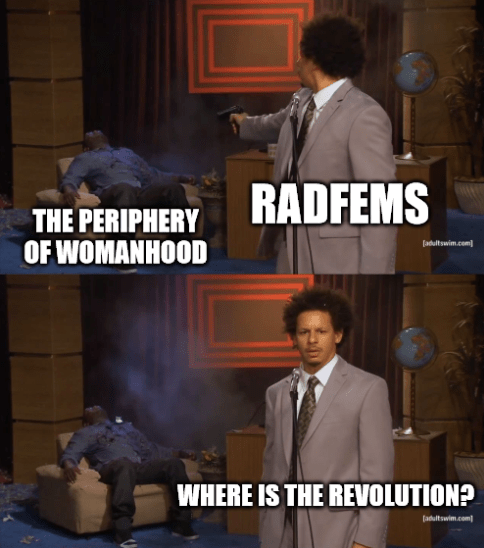
For me, workerism, or tailism, constitutes an abandoning of the periphery, sanitizing resistance – defanging it.
First you define the working class in a way that doesn’t include its most radical aspects – and then you complain about the working class being weak. It sanitizes resistance, and then complains about the lack of radicalism.

- 3: Pragmatic workerism, or, a term I made up right now to further my argument about how bad the positions in the first two points are: even if it was true that ”actual real workers who matter” (who decided they were the core?) were reactionary, isn’t it the task of radicals to radicalize? To use more archaic language – to raise class consciousness in these reactionary sections. Fascism could then be seen as the malcontent of workers without the lens of class conciousness, instead replaced by the lens of authoritarian annihilation of all that is other.
Is it not a problem how a group can be deemed radical or revolutionary and therefore good – and because of this, everything it does must originate from this inherent radicalness?
To use problematic language – isn’t it a sort of slave morality, thinking oppression equals purity? A form of ressentimente, that this suffering of oppression must have been for something – that it purified your moral character, made your every cause just – and anything providing proof of the opposite is a existential threat since it shows to you the true meaninglessness of that suffering.
What if the suffering is indeed for nothing – and that thinking it was not leads to only bearing it further – instead of casting it off?
RADFEM ❤ WORKERISM
For radical feminism, instead of the figure of the worker, the woman is the central symbol. It is the everyday woman, the 99% who defines gender by biology, who has never questioned their identity, because those questions were invented by Queer Theorists who only aim to splinter the group. The woman is a person who needs actual healthcare – instead of the faggots stealing resources for aesthetic proceedures. It is the woman who give birth to Every Child, without which society wouldn’t continue. The woman who does the Actual reproductive work, without which society wouldn’t function. Since this group is many, their needs outweight those of the few, and we need to primarily focus on the needs of the many.
I think a reoccuring thread throughout radical feminist theorizing is in confusing the concrete for the abstract. Elevating your immediate surroundings to universal: what is universal stop being THE surrounding, but instead becomes just your specific surrounding. The personal is political – as in that all the negative things you face in your personal life are examples of oppressions.
Just as there is nothing uniquely Good about workers, there is nothing uniquely good about women. oppression has never, and will never lead to purity – rather the opposite, through desperation. anyone would do the worst deeds throughout history given the position, and emotional mutilation that created the people making them. no, women are neither uniquely good nor bad.
However, it is in oppression that one of the greatest good arise – solidarity in resistance. capitalism breeds invention – but not like they think. Instead, the invention is through us on the edges always finding a new way to live even though the world makes it endlessly hard to do so. Among the ones with greatest desperation, both the worst and the best exist at once. To remove this periphery from the analysis, you get a sanitized class, clean of the filth of actual resistance. and by the time enough time has passed after the actual resistance – you can appropriate it and claim its always been apart of the sanitized class.
Still, much like workerists, this radical feminism obsess over materialism – decrying the ”idealism” of its every opponent that doesn’t share their exact position that any theory or movement should be aimed towards the Woman specified in the paragraph above.
However, to be honest, I do find it even worse when it is about women – since it posits the oppression as fundamentally being about base biology, something part of a ”natural order”. Seeing womanhood as primarily a class defined by an idealized biological ability, they are not materialists. it would be like seeing all humans as workers because we all have the biological ability to do work.
Instead, I think a real materialist (excuse my using it as a linguistical bludgeon) feminism would focus especially on the work that is done, and define the class based on who does that work. To expand on what I think this would imply:
I think that from a marxist perspective, it is not enough for a group to serve a function for it to be revolutionary – it must have some sort of revolutionary telos. That is, it must have a tendency, when traced to its end, constitutes an overthrowing of what constitutes it. This is of course something completely forgotten under the need to justify the borders of womanhood here and now. Instead of starting with the group centered around the symbol of the Woman, and then trying to justify how it is revolutionary – we should start with the work the oppression is structured about – reproductive work.
First off, reproductive laborers are a far wider group than women, and talking about Women as a shorthand for reproductive workers is both too wide and too narrow a description. Too wide because it includes bourgeios women. narrow because it excludes non-women doing this same work. Instead of discussing function, Woman speaks of identity. If there is a revolutionary subject of patriarchy, that subject must be the reproductive laborer – not the woman. One way to attempt to limit reproductive work to the Woman is limiting reproductive work to specifically childbirth. Do I even have to mention why this is extremely reductive?
If feminism should be marxist, then womanhood itself cannot be the class. Of course, you can have marxist analysis specifically about womanhood – but what you cannot apply dialectical materialism directly upon the dynamic between men and women – because the dynamic is actually in between reproductive workers and partriarchy.
However, I do think it is important to note that this dynamic is often ideologically coded as specifically woman/man, akin to how class dynamics are often racialized to justify oppression, since taking an already existing axis of oppression to justify a worse working situation is a classic way that capitalism makes money. Note here that I do not say those other axis of oppression doesn’t exist – just that using marxist analysis of (re-)productive classes does not work for every oppression, since not all oppression is based on the societal structuring of (re-)production.
My idea is then, that there are two oppressions at play here: one of the reproductive worker, and a second one of women. These two are often confused with each other since they overlap so much – something that is harmful to both groups. A discussion could be had for which came first – but genesis is not the same essence; where something came from doesnt define what it is.
Feminism then, has everything to gain by not furthering this split. By arguing for liberation for reproductive workers, and theorizing for how this should occur – only using the character of the Woman, is harmful for the goal intended. There should obviously be much solidarity – especially since women are much, much more like to face exploitation as reproductive workers – but it isn’t contingent, or an essential part of reproductive work that it must include women.
CONSEQUENCES
By confusing the reproductive worker with the woman, you make womanhood into a prison people who do not find themselves in have to be inside for you to see them as possible allies. An important group affected by this are those of non-binary genders who cannot eally exist within this sort of theory. The duality of men and women is a totality – there is nothing outside of it except after a potential future overthrowing of patriarchy. If you are nonbinary and was AMAB (assigned male at birth) – it is then a very short trip to being called a male infiltrator, and if you are nonbinary and was AFAB (assigned female at birth) – as a woman engaging in a sort of ”not like other girls” behavior, thinking you are better than other women by not wanting to call yourself one. Respecting the pronouns of these people become a matter of individual respect that can be given or taken depending on the moral character of the person in question.
I find this also affected trans women, and complexly, through them, affecting non-binary people again. Since the ideology defines women as a group in their opposition to Man as the enemy, any sign of his presence is a threat. Due to the historical connections between trans women and men (having been them), trans women are fundamentally suspect. This means it is required of trans women to prove themselves as a woman to your surroundings by hating men. By distancing yourself as much as possible from any form of maleness, you can receive the affirmation of the Real Women around you – who are the best ones who can give affirmation of your womanhood – especially because of their interest to define the borders of womanhood.
An aspect of the above is through the concept of gender socialization. The idea is that gender is internalized psychologically through (childhood) socialization – which then has to be undone by trans women. Any sign of remaining male socialization puts the trans woman into the position of an oppression, which justifies punishment of them. What counts as male socialization, is obviously decided by cis women. I think that the main issues with the concept being used like this, except for the obvious fact that it is mostly used as a weapon to wield power over trans women in their lives, is the fact that it sees socialization as something that has occurred before, and not a constant process. They let go of how gender is created in the moment, in the dynamics of the room you find yourself in – but instead only focus on history, origin. And, besides, aren’t women punished when acting unwomanly – which is something ”acting according to male socialization” definitely is?
The threat of the weapons against trans women described above, has severe consequences. Partly, living in fear of this weapon creates the need for justification why you do not deserve to meet it, by attempting to distance yourself from any signs of you not being an ally to the cause. One part of this is folding transphobia into misogyny – that is, transphobia doesn’t exist, it is only misogyny in another guise. Transphobia doesn’t exist, because trans women are women. Implications of this are that the oppressions non-binary trans people face becomes theoretically non-existant. When it comes to trans men, they are oppressed due to their more fundamental, biological oppression shared with women, but not for being trans.
NOTE
To be clear, I used to be a part of this feminism. My self hatred was used to control me, a control intensified by disposability. Is this me just generalizing my specific experience with this group?
I do not think so. A class is nothing but a potential, and if that class coalesce around reactionary ends, it does not matter if you are oppressed or not – it is still reactionary. Just like workerism is reactionary, this radical feminism is aswell. I doubt if it is even salvagable since as I see it, it is either trans exclusionary, or it is theoretically incoherent; a compromise to seem nice to your ”friends” who doesnt fit into its strict framework. Any attempt to salvage it to make it more coherent will make it more transphobic. Any attempt to make it less transphobic will make it less coherent. I think the only alternative is letting go of it, but of course, maybe borrowing some of the insights is acceptable.
Being alone in a room with a radical feminist woman will always includes a third person – the abstract Man. A construct that brings meaning to their existance as belonging to the class of woman. To be accepted as a trans woman means proving your opposition and difference to this abstract creation. It is an incredibly addictive and destructive situation that plays perfectly into feelings of dysphoria. You have to attempt to distance yourself as for as possible from who you were – by proving your hate of men, to be let in – but it is still never enough. You learn to be afraid. For men to be let in, they also have to prove their self-hatred, as if that in itself was benefical to anyone. As if it made anyone safe. It is the building of a secular original sin where the end goal is only coming out as the most moral person, taking any chance you can to prove that your self-hatred exceeds others as if separation was the solution to any and all political challenges. It is the logic of prisons. it is the logic of blood and soil. it is the logic of oppression itself.
If there is one thing I have to thank this sort of radical feminism for, it is for it helping me become a woman, in the sense that it my experiences with them made me learn how the oppression women face feels on a personal level.
Community, or, a Conclusion
What I see them in, is a slow reactionary radicalization spiral. They alienate more and more of the people in their communities – and then blame this alienation on the ones alienated, on transgender ideology, on queer theory – while they spiralling further and further.
I think many of them are aware of it, since they are (sub) conciously ahead in their radicalization from what they dare to say, write or maybe even think. Therefore, their radicalization gets further reinforced by a sort of perceived self defence – they knew if they were honest, theyd lose support – and that hurts – and this hurt becomes coded as being the fault of queer theory or similar enemies. Therefore, any sign of their future estrangement due to their radicalization, becomes fuel for the radicalization itself.
The opposite process occurs for the trans women in these communities – the alienation increase the more the radicalization occurs, but here there is no liberation, no ”step” to take. Frog in boiling water. The only way out is giving up your friends. This can be terrifying, and maybe even close to impossible due to the precarity many trans women find themselves in.
As an ideology it can be compared to a black hole. In its fear of the outside, it spirals further and further inwards, rejecting the outside more and more until it becomes the visage of death. It is by definition a fascist becoming, a microfascistic thread. To propose the abolishment of the outside (ending queer theory or whatever), is of course ridiculous, and is only the answer of someone already deep inside of this radicalization spiral
 Verafied Theory