Recently I made a post called Philosophical Applications of Dynamical Systems Theory. In it I provided a short overview of how simple forces lead to complex behaviors, and how a graph will, over time, stabilize into either a single line – or an oscillation between 2, 4, 8 points, in a doubling fashion – depending on the magnitude of the force depending on limiting factors.
So: I think you can see people acting in the same way after trauma. There is a stable oscillation, in response to the world – but then an event of such intensity occurs that it tears this oscillation out of stability, into chaos: ”peaking”, distorting, at the edges of our consciousness. All we know is that we are experiencing something that we have no word for – which makes our words lose their purpose.
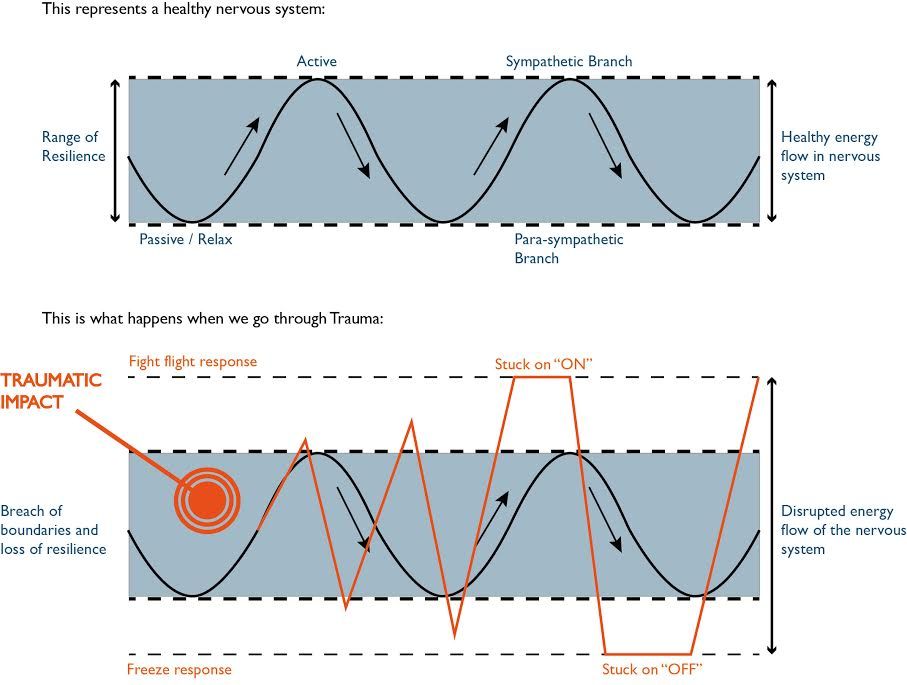
”Peaking” is a term from music production. It means that the sound is reaching maximum volume, the ”roof”, leading to compression and distortion. Distortion could then be described as the intensity of an event exceeding the capabilities of it’s medium. I think we can see this happening in places other than music production. It is a concept applicable to numerous of processes. One example could be talking in a language you are not completely fluid in – what you are trying to convey is ”capped” by your ability to speak in that language, causing breaks, maybe stuttering, and so on. You get an idea, but the medium you have to use to convey it in is limited, leading to distortion.
That said, I do not really believe in such a perfect distinction of form and content – but we do not have to describe it in that way for this concept to be valid. It is just as valid to describe when you are trying to express one entity through another; fitting a triangle through a round hole. Peaking is a sign that the shape of the entities you are expressing, versus the ones you are expressing through, are incompatible, and one of them needs to be rejected. This distortion is painful, it is not being able to explain, even to yourself, what is occuring. Either you reject the traumatic event, or you reject who you have been. One is denial, the other is the death of who you have been.
I remember this account by Spinoza (via Deleuze) of the garden of Eden and the fruit of knowledge – when it was said the apple was poisonous, it was not a lie. It was lethal, since when it is eaten, it essentially, fundamentally, changes who you are. You will never be able to go back. Who you were is now dead. In response to us being thrown into chaos, we are forced to try and find a new equilibrium. Not doing so would be the same as rejecting trying to understand what has happened, and instead to try and go on. What we do when we try to make sense of an intense traumatic experience, is to bring ourselves back into stability. To live knowing what has happened, and hopefully not have to go through it again. That is, finding new identity. By identity here, I mean the same as what I described as ethics in my post Speculative Ethics – a way of being, or a code of conduct. Or, even wider, in the philosophical sense – identity as what makes a thing what it is. In this regard, creating new concepts could be seen as creating new identity, since it is a new way of interacting with the world.
This account of trauma is what I have decided to call a traumatology. Trauma is, according to it, an engine behind identity. Or, put into other words: trauma is a(/the) condition of identity.
There is a resemblence to this, to something I heard read by xenogothic, from the introduction of his new book, Egress. (1:04:00) From what Mr Xenogoth is saying, I feel like Bataille would be a perfect reference point for what I am writing on here. What I describe as trauma, is very similar to what Bataille seems to describe as limit experiences. However, all I have read by Bataille is The Story of the Eye, and I feel it is a bit beyond the scope of this simple post to get into it him more. Mr. Xenogoth discusses the event of the death of Fisher, in relation to how Maurice Blanchot writes after the death of Bataille (in response to a critique by Jean-Luc Nancy), that there is an openness resulting from the experience of death, caused by the rupture of community. Death is an event that reveals to us the communities we are part of. Community does not always appear as such until the moment at which it is called into question. Mr. Xenogoth means that this is what the death of Fisher led to – communities being solidified, revealed, and created.
The introduction of Egress starts out as very factual descriptions on the experience of hearing about the passing of Fisher – locations and googlings. The pure concreteness of the event of death, tearing past all metaphor. The text seamlessly moves from this rawness into theoretical understanding, mirroring how you scramble to Understanding to get out of the chaos of the pure event. This reflects another piece of media from a few years back – Mount Eerie’s A Crow Looked At Me.
The album deals with the Phil Elvrum’s (the songwriter and main artist behind this project) experience of watching his wife die in cancer, and being left alone with their 1-2 year old daughter. This is described through the mundane simple facts, overloaded with meaning from the brutality of the event – the throwing out of ”end of life tissues” and underwear, still getting her mail, or taking out the garbage at night. There is a part in the song Forest Fire that for me is one of the most potent moments on the album:
This whole past summer was a lingering heatwave
And I remember late August, our open bedroom window, going through your things with the fan blowing
And the sound of helicopters, and the smell of smoke
From the forest fire that was growing, billowing just on the edge of town where we used to swim
They say a natural, cleansing devastation, burning in the understory, erasing trails, there is no endBut when I’m kneeling in the heat throwing out your underwear
The devastation is not natural or good, you do belong here
I reject nature, I disagreeIn the hazy light of forest fire smoke, I looked across at the refineries and thought that the world was actually constantly ending
– Forest Fire, Mount Eerie (lyrics)
The line ”I reject nature, I disagree” is in particular what I am referring to – since nature has been a main subject of his songwriting, seemingly on a very personal level.
Another is the first line of the album, which is a very powerful opening:
Death is real, someone’s there and then they’re not
– Real Death, Mount Eerie (lyrics)
And it’s not for singing about; it’s not for making into art
The apparent contradiction is clear – if it is not for singing about, and not for making into art – why is Elvrum doing just that? My answer would be that making art, and singing, is his way of being, his code of conduct. The event of trauma requires to be accounted for, for you to survive. You need to reduce the alterity of the impossibility of death into yourself somehow, it becoming a part of you. Since this is an impossible task, the event will be bent out of shape for you to survive. It will fade into metaphor, into concepts, which measures it up, divides it, explains it.
While A Crow Looked At Me stays with the raw concrete lack of metaphor most of the way through – his later albums has, in some sense, consolidated this experience more into metaphor (and into Elvrums self-mythologizing). It becomes a point of reference the rest is related to in some way. A point of departure for new stories.
This reduction of the alterity of the event into identity is never a reduction into who you used to be, it is always productive, always creative. Trauma is what forces us to change, it is the reason why we can never stay, never be content. To not create is to drown in history. Being a living individual is not a static being – it is a process of constantly repositioning yourself in the world, and the novelty of each historic moment requires creativety to be able to survive.
Returning to Egress, and to relate it to Mount Eerie’s A Crow: I think communal trauma and personal trauma works by similar mechanics, and there is no true distinction between them. However, the prior is what forces us to create new communities, and new ways of relating to each other. The traumatic experience of capitalism, for example, is a driving force behind active communizing projects. Or, an even better example is, in my opinion, the queer communities.
In my earlier post on Speculative Ethics, I wrote of a thing I called ”strange becomings”. A spiraling out into weirdness. If trauma is the engine behind identity, it becomes clear that a consequence is that some circumstances might lead to the creation of strange ways of being, in the eyes of others. This can in turn lead to new trauma as a result of others perceiving you as a chaotic aspect of the collective identity (for example, degeneracy as the death of ”our civilization”) that needs to be controlled and reduced into their conception of the collective. This traumatic experience requires you to find a new equilibrium, even stranger. So you find yourself in a feedback loop of becoming, stranger and stranger, being forced to constantly recreate yourself in order to be able to somehow position yourself towards what is occuring to you.
This is a bit simplistic though, of course. Becoming-other, and the experience of being treated as other, is not the only thing fueling strange becomings. It is also fueled by novel ways of being also leads to unique and previously unencountered problem and conflicts. I suppose this is how you can wake up one day and discover that you have become a Deleuzian Cyberprimitivist Gender Nihilist Trans Woman Lesbian Relationship Postmodernist (don’t ask me what I mean by this (one of my old profile pictures in the link)). I do not feel like I have become who I am as a choice, but neither was it decided for me. I did it to survive, and to avoid certain trauma. It is the result of creativity in the face of death.
I also want to clarify that I am not entirely serious by writing those identifiers. I think that identity works on another level than language, so they are more to be considered some silly pointers towards how I conduct my life, rather than claiming some sort of community or political coherence behind them. I also have plans to further discuss traumatology in relation to sexuality, gender, and relationship ”molds”, in a future post. Especially, I want to provide a critique of certain strands of thought that would like to see the concept abolished.
As a conclusion (for now), I think traumatology is applicable to a wide varierity of occurances. I was reading Ballards The Drowned World the other month, I came to think about how genetics could be seen as some sort of inherited trauma – integenerational and interspecies memories, going back as far as life – telling us what bodies what to do and not, to remain within equilibrium, but constantly forced out of it. I remember seeing a quote by Darwin, posted by the twitter account Build Soil:
The face of Nature may be compared to a yielding surface, with ten thousand sharp wedges packed close together and driven inwards with incessant blows, sometimes one wedge being struck, and then another with greater force.
Darwin, On the Origin of Species (via Build Soil)
I will end this post with a poem I wrote about that time, on the topic of many of the things I have been discussing in this post:
world history
there is a meme that seem to depict
an ancestor of humanity,
(of course, a fish)
with the caption:
”your ancestors are watching.
make them proud.”
so remember that the people that dreamt of the fall of rome
were not alive when it occurred.
and their children ended up
committing genocides much worse
than can be thought.
(aren’t oppressors
the inheritors of cowardice?
the children of the ones
that decided to give
into assimilation,
instead of risking
the death of refusing.
i am the inheritor
of this cowardice,
i seek to refuse it,
aware of the risk.
to the question:
”don’t you think a descendant of oppressed people is better off as a supermarket manager or police chief?”
Fredy Perlman once answered, in his essay ”On the Continuing Appeal of Nationalism”:
”what concentration camp manager, national executioner or torturer is not a descendant of oppressed people?”)
world history is the story of intergenerational trauma, occurring fractal-like.
(because what is a life
but a response
to the historic
conditions that you
are forced to endure?
what is the family
but the space
for the neo-
liberal age
to externalize costs
unto labor,
which is unpaid?
what is the state
but family structures
reified
into a subject?)
a mandelbrot set
of the trauma
best at over-
coding all –
but the things
that refuse
are to be
sentenced to death
our time is like
a ghostly after-
image of
an ended line
justified
by nothing more
than a frightful sight:
bifurcation,
increasingly wild.
into chaos,
both mental and not.
i sing of nothing, a quiet hum;
a level head, to be calm.
i look at pictures, i become
aware of movement in the hall
when you dream about each other
how does it differ from
a meeting in faces
but nothing is there,
my thoughts are neither
but i face the intruder
and hear them say
that: ”i am a lie
that you told yourself
to distract,
and confuse
and i reject this life.”
and the ideal became nothing
i’m face to face
with my conditions
i now see
that i can’t refuse
so i sing more clearly
(i no longer hum)
and i dream of you
and hope you refuse.
and remember to make
your ancestors proud.
 Verafied Theory

En reaktion till “Traumatology”